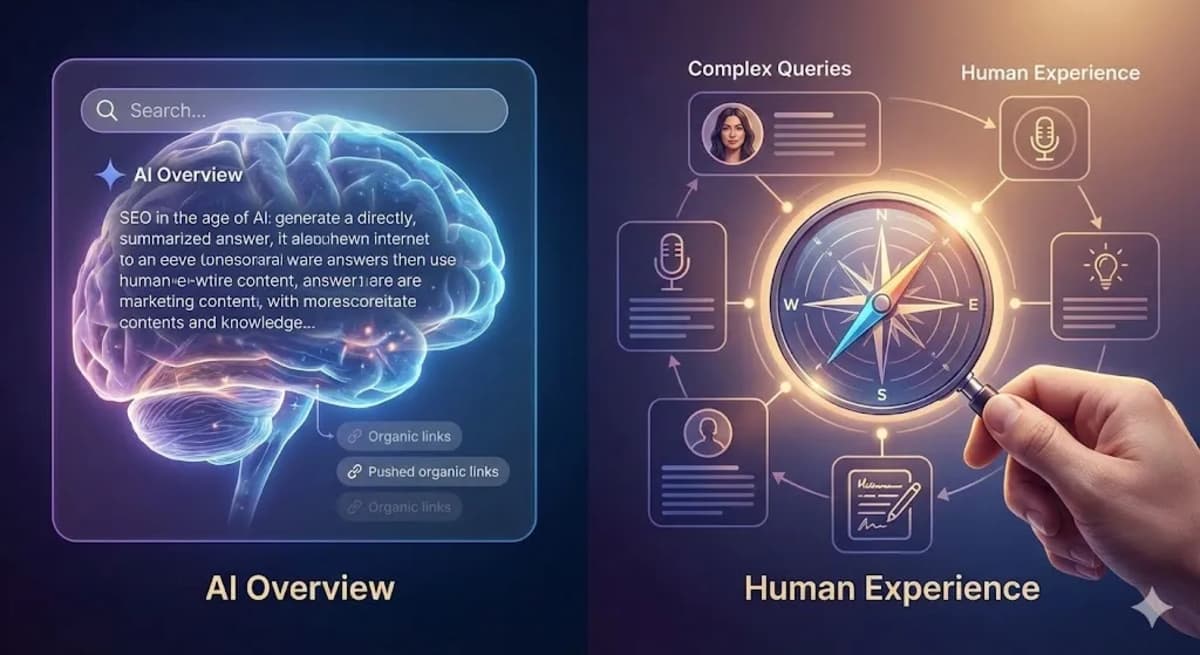
With Google's AI Overviews (SGE), the SEO game has changed. Here is how to rank when AI gives the answers directly.
For the past two decades, the contract between Google and websites was simple: You create content, Google indexes it, and sends you traffic. In 2026, that contract has been rewritten. The introduction of AI Overviews (formerly Search Generative Experience or SGE) means that Google now answers user queries directly on the results page, often pushing organic links way down the fold.
Is SEO dead? Absolutely not. But "Old SEO"—keyword stuffing, buying cheap backlinks, and writing generic 500-word articles—is definitely dead. To survive in the Age of AI, we need to adapt to a new set of rules.
Optimizing for the "Zero-Click" World
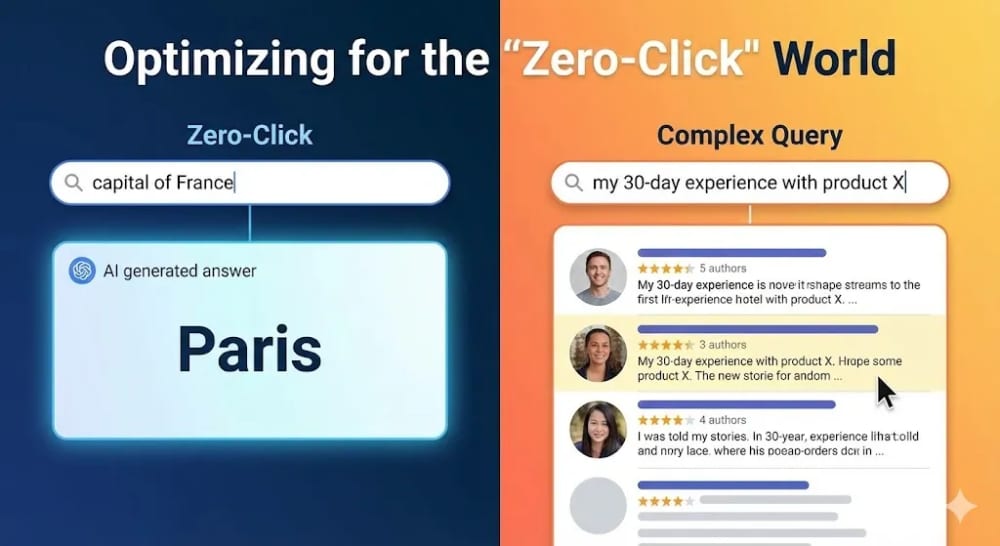
The reality is that for simple queries like "how to tie a tie" or "capital of France," AI will give the answer, and the user will never click your site. You cannot compete for these "Simple Queries" anymore. You must pivot to "Complex Queries."
Complex queries require nuance, opinion, deep experience, or fresh data. AI is a summarizer; it is not a creator. It cannot replicate genuine human experience. Content that says "I tried this product for 30 days and here is what happened" is infinitely more valuable than an AI summary of product specs. We need to create content that goes deeper than the AI can go.
The Rise of E-E-A-T
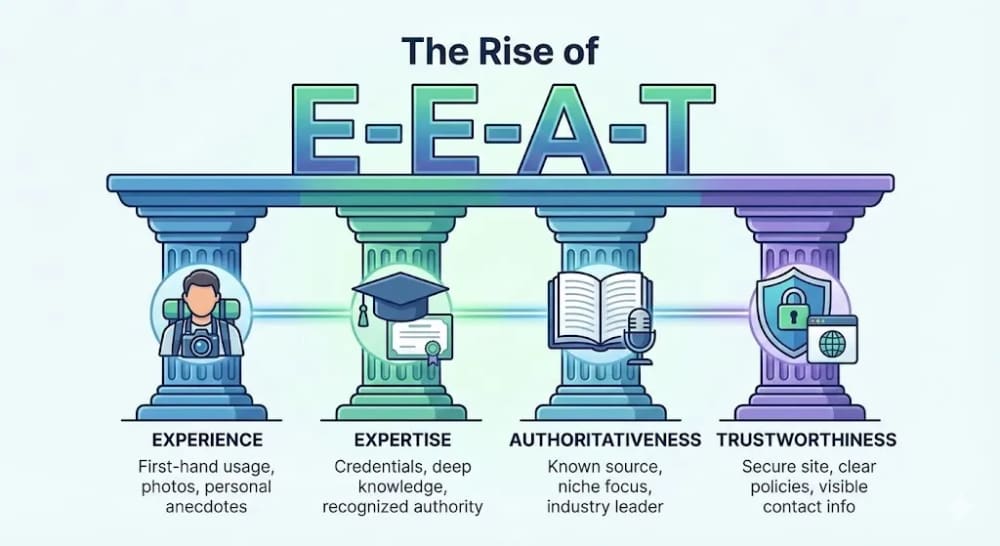
Google's counter-measure to the flood of AI-generated spam is E-E-A-T: Experience, Expertise, Authoritativeness, and Trustworthiness. This is now the most critical ranking factor.
- Experience: Does the author have first-hand experience? (Use photos, videos, and personal anecdotes).
- Expertise: Is the author a recognized expert? (Credentials, bios, and LinkedIn links matter).
- Authoritativeness: Is the website a known source for this topic? (Niche down, don't cover everything).
- Trustworthiness: Is the site secure? Are policies clear? Is contact info visible?
If your content looks like it was written by ChatGPT, Google will bury it. You need to inject "Humanity" into your content. Use "I" and "We." Share failures. Share strong opinions. Be distinct.
Topic Clusters over Keywords
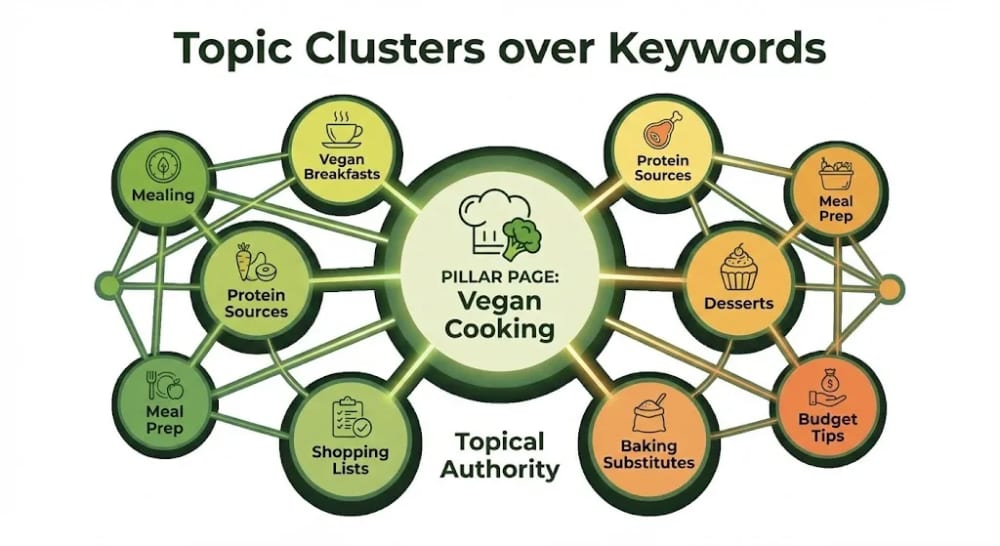
Google no longer looks at individual keywords in isolation; it looks at "Topical Authority." You cannot just write one lucky post about "Vegan Recipes" and rank. You need to cover the entire entity of "Vegan Cooking"—breakfasts, protein sources, shopping lists, meal prep.
This strategy is called "Topic Clustering." You create a central "Pillar Page" that covers a broad topic, and then link out to dozens of supporting "Cluster Pages" that cover specific sub-topics. This internal linking structure signals to Google's AI that you are a comprehensive resource on the subject. Our SEO packages include full topic cluster strategy and content execution as part of the monthly scope.
Technical SEO is the Foundation
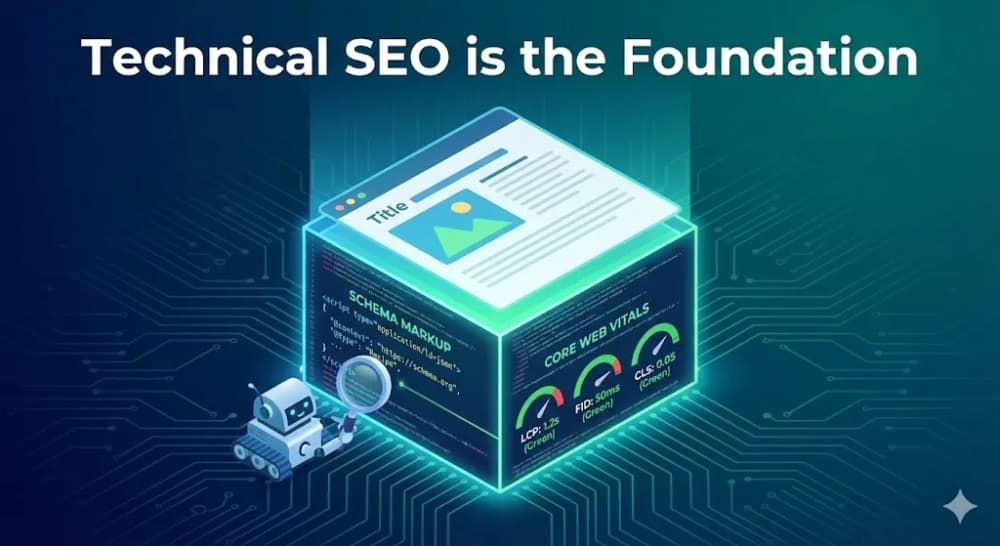
With AI crawlers working overtime, your site's technical health is paramount. Core Web Vitals (speed, stability, responsiveness) must be green. Schema Markup (structured data) is now non-negotiable. Schema is the code that helps machines understand your content (e.g., telling Google "this is a recipe," "this is a review," "this is a video"). If you don't speak the robot's language via Schema, the robot won't feature you in the AI snapshot. (Need help with technical optimization? See our Web Development packages).
SEO in 2026 is harder, but the rewards are higher for those who do it right. The shift is from volume to depth, from generic content to genuine expertise. At Designing Dose, our SEO packages start from €299 per month and are built for the AI-first search environment: schema markup, topic clustering, E-E-A-T signal building, and monthly performance reporting. Get in touch and we will audit your site for free before you commit to anything.