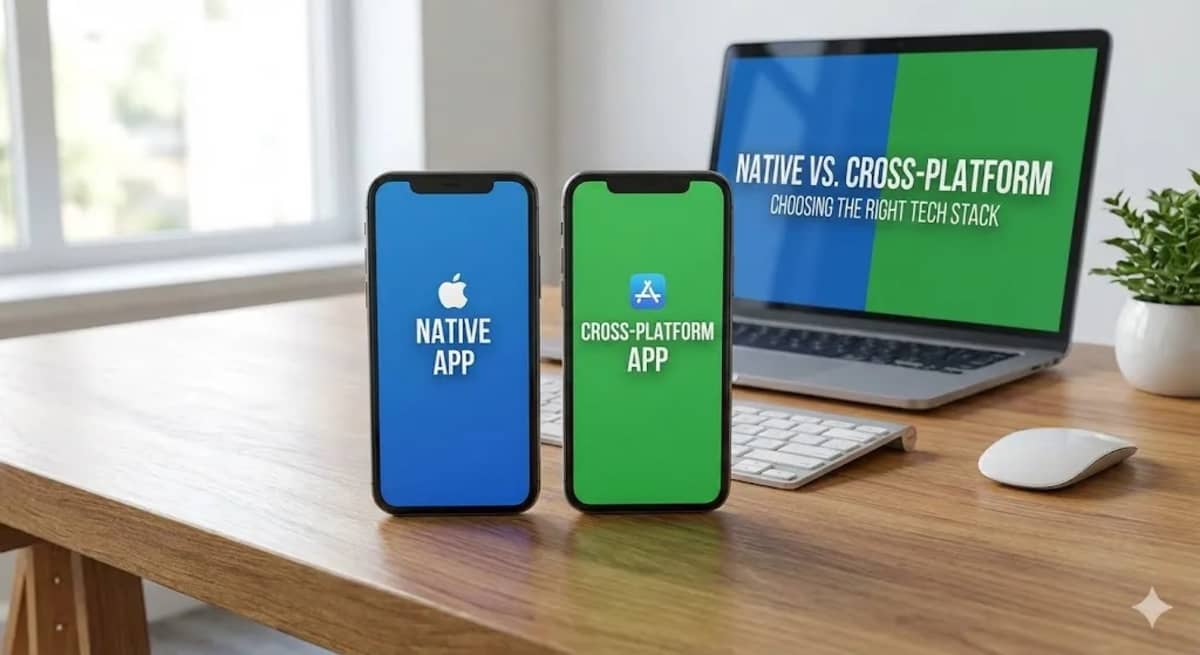
Building an app? The biggest decision is your tech stack. We compare Flutter, React Native, and Swift to help you save money without sacrificing quality.
When you decide to build a mobile app, you are immediately faced with a critical technical decision: Native or Cross-Platform? This choice will dictate your budget, your timeline, your app’s performance, and your long-term maintenance strategy. Make the wrong choice, and you could burn through your runway building two separate apps when one would have sufficed. Or conversely, you could build a sluggish app that frustrates users because you tried to cut corners.
To make an informed decision, we need to look beyond the buzzwords and understand the architectural differences between these approaches in the context of the 2026 mobile landscape.
Option 1: Native Development (Swift & Kotlin)
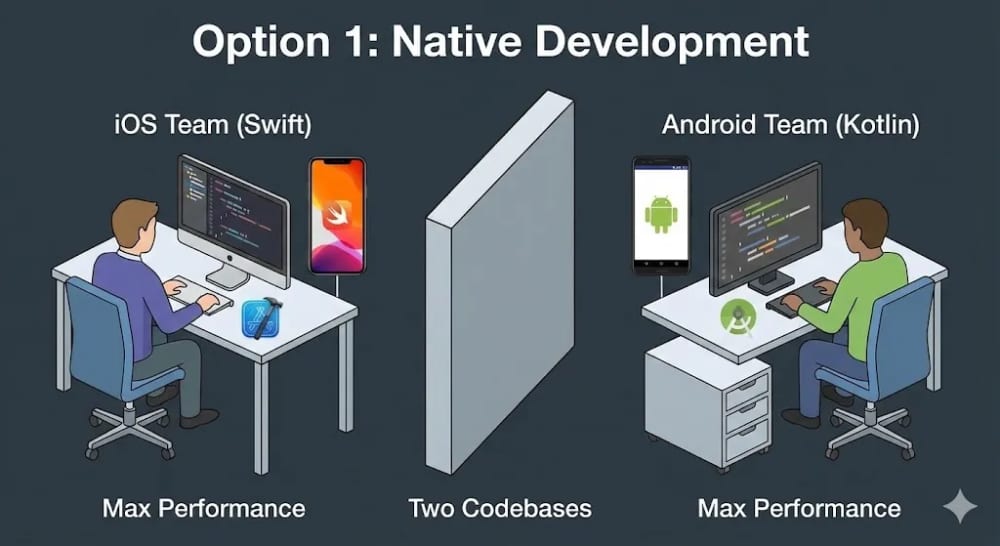
Native development involves building the app specifically for the operating system using its official language—Swift for iOS (Apple) and Kotlin for Android (Google). This is the traditional way apps were built.
- Pros: Unbeatable performance. You have direct access to the metal of the device. Complex animations run at 60fps or 120fps without breaking a sweat. You have immediate access to the latest OS features (like ARKit or CoreML) the day they are released.
- Cons: Cost and Time. You are essentially building two completely separate products. You need two codebases, two development teams (one iOS, one Android), and double the QA testing. Any update or bug fix has to be implemented twice.
Option 2: Cross-Platform (Flutter & React Native)
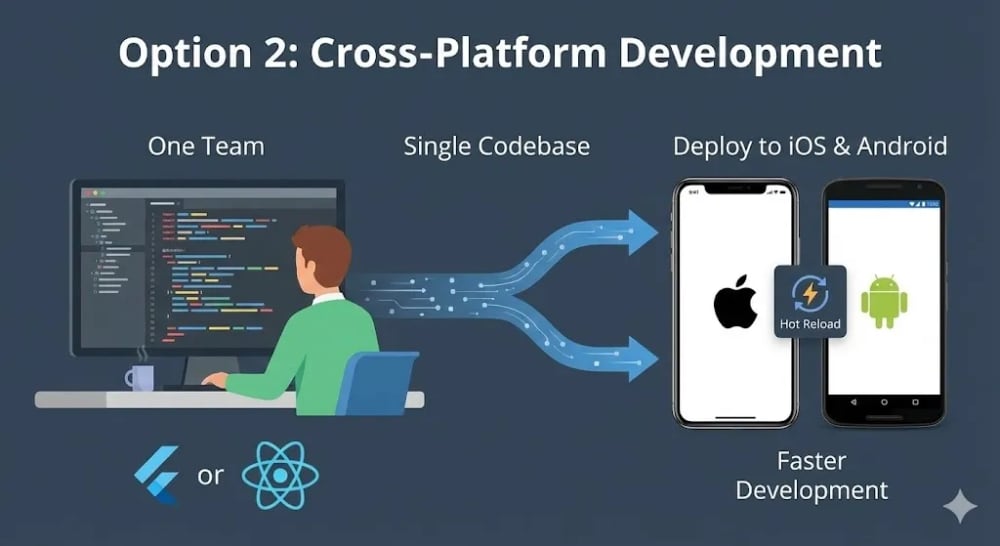
Cross-platform frameworks allow you to write code once and deploy it to both iOS and Android. The two heavyweights in this arena are React Native (created by Meta/Facebook) and Flutter (created by Google).
In the past, cross-platform apps (like PhoneGap or Ionic) were just websites wrapped in a browser shell. They felt "off"—sluggish, weird scrolling, non-native buttons. However, React Native and Flutter have completely changed the game. They compile down to native code (or draw directly to the canvas in Flutter's case), offering near-native performance.
- Pros: One codebase for both platforms. This can reduce development time and cost by 30-50%. You only need one team. Feature parity is guaranteed across both platforms. Hot Reload allows developers to see changes instantly, speeding up the build process.
- Cons: There is still a slight performance overhead compared to pure Native, though it is imperceptible for 95% of apps. Accessing very specific, new device hardware might require writing some "bridge" code in native languages.
Our cross-platform app packages start from €6,499 for a functional MVP — built in Flutter, deployed to both iOS and Android simultaneously.
Performance vs. Efficiency Trade-off

The Verdict: What Should You Build?
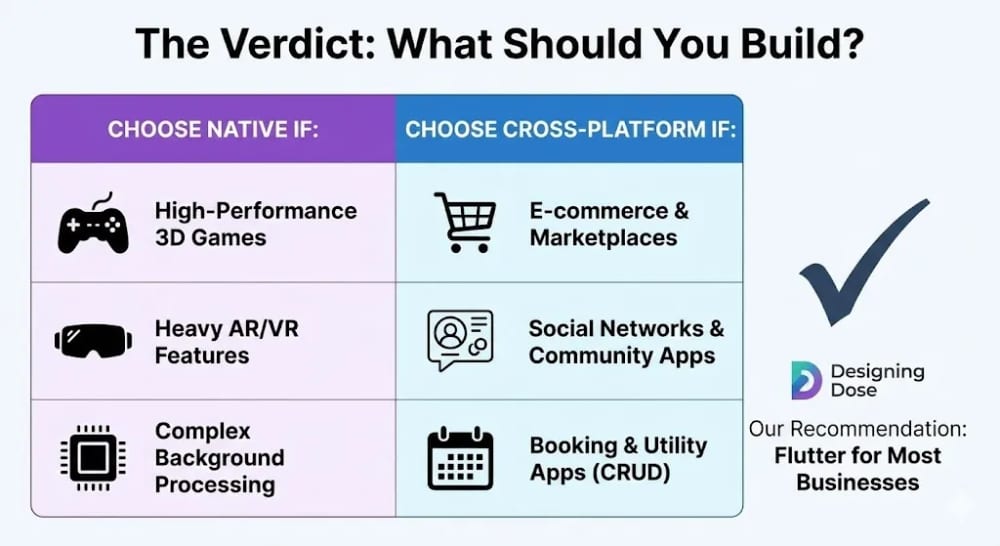
So, which path is right for your startup or business?
CHOOSE NATIVE IF: You are building a high-performance 3D game, an app that relies heavily on Augmented Reality (AR), or an app that needs to do heavy background processing or video editing. If milliseconds of latency matter, Native is the only way.
CHOOSE CROSS-PLATFORM IF: You are building an e-commerce store, a social network, a delivery app, a booking system, or an internal business tool. For these "CRUD" (Create, Read, Update, Delete) style apps, Flutter or React Native is the superior choice. You get to market faster, save money, and users will never notice the difference. Our MVP Launch package starting from €6,499 is the fastest path from idea to App Store.
At Designing Dose, we build in Flutter because it gives modern businesses the best balance of speed, design quality, and cost-efficiency. Our app development packages start from €6,499 for a fully functional MVP deployed to both iOS and Android on day one. Book a free scoping call and we will map out exactly what your app needs to launch successfully.